Friday, August 20, 2010

Live And Let Die

"When you were young
And your heart was an open book
You used to say live and let live
(You know you did, you know you did, you know you did)

But if this ever changin' world
In which we live in
Makes you give in and cry
Say live and let die"

"Live And Let Die" by Paul McCartney & Wings

I was so fortunate to join a friend this week for the Paul McCartney concert at the new Consol Energy Center (The Coal Barn). This was the first time I had ever seen Sir Paul and it was really surreal. It was like watching history, live. The show and the Center were fabulous, but this trip down memory lane really got me thinking about how things have progressed from the '60's to today. In the '60's we had race riots, and Vietnam, but there was also a pervasive feeling that we could overcome these issues. In the '70's Nixon abolished the gold standard, we had some serious inflation and a couple of brutal recessions, but again there was that sense that eventually things would get better. Finally the '80's came and ushered in a couple of decades of prosperity. Inflation was broken (thanks Paul Volcker), technology lead to a boom in productivity, and the government piled on the debt to make sure that the "American Dream" would live on.
You know the "American Dream" right? That's the dream that even though times may be tough, if you work hard, at least your children will have a better life than you. 
I'm not sure exactly how this changed, but somewhere in the last couple of decades, the belief in hard work to better your future was supplanted by the belief that the government will take care of our future. And I give our friends in Washington credit, they tried. They borrowed and promised, and borrowed and promised, and for a while we all felt pretty good. 
I can't help thinking of this Baby Boom generation, going through the decades; living, loving, fighting, working, saving, growing a little heavier and more than a bit worried. Have we moved from "live and let live" to "live and let die?" In some ways I think we have. Many of us realize that our prolific past, like our waste lines, needs to be cut. We're doing it personally, and we're starting a movement to see that our elected officials do it too. 
It's fascinating to watch governments around the developed world attack their weight (debt) problems. In Europe we see varying degrees of dieting going on (also known as austerity). Some countries just need to lose a few pounds (France), while others are clearly obese (Greece). Some countries just need to make a few lifestyle changes, while others may need more drastic measures, such as gastric bypass surgery (default and debt restructuring). 
In the US we are stuck in the middle, while some of us clearly recognize our weight problem, many of us still think that it's OK to be pleasingly plump. There is clearly a large contingent in DC that believes that we can continue our prolific ways, but I believe that their days are numbered. That's the beauty of this country, as Sir John said, "What does it matter to ya, when ya got a job to do. Ya got to do it well, you got to give the other fella hell."

Investment Implications:
We did a few trades this week, that were surprisingly all buys. The reason I say surprisingly is that the general mood out there is definitely bearish. But, in the past couple of weeks we've had the Fed come out and state as plainly as possible that they will have a Zero Interest Rate Policy for as long as they can see. And since the economy is not showing much in the way of improvement they will soon begin QEII (Quantitative Easing II), in which they will purchase Treasury securities. In other words they are very concerned that we are slipping into a double dip recession (maybe we never really got out of the first one) and potential deflation. This caused a significant rally in Treasuries and just about every other interest paying security. Ten year Treasuries are at 2.6% and two year Treasuries are at 0.50%. Mortgage rates are also at record lows. So just about every fixed income security we own has moved to bullish territory and we are nearly at maximum weight in fixed income.
This caused us to add to WIP (SPDR Int'l Government Bond TIPS).
We also added to both US REIT's (VNQ Vanguard MSCI REIT Index) and International REIT's (IFGL iShares FTSE/NAREIT Global-ex US), which are sought after for their high yields.

The other event that has been taking place of late has been the run-up in most agriculture commodities. You're probably aware of the draught and fires in Russia, and the massive flooding in Pakistan. These events as well as continued demand growth from emerging markets has caused some severe price shocks in wheat, corn and soy. On top of this fundamental demand we also have the hostile takeover attempt of Potash that is causing all fertilizer stocks to appreciate.
This has triggered buying in DBC (PowerShares DB Commodity Index), MOO (Market Vectors Agribusiness ETF), and CRBQ (TR/J CRB Global Commodity Index).

Last but not least we have had EFA (iShares MSCI EAFE Index), our core international equity holding, move from bearish to neutral.

Overall our cash equivalents dropped from 27.5% to 16.5%.

Longer term I remain generally bearish, but I remember the old saying, 
"Don't fight the Fed, and don't fight the tape."
 
Kyle Bass Interview:
This is an excellent two part video interview with Hayman Capital's Kyle Bass, who called and profited handsomely from the subprime implosion.
His main thrust is that he expects several sovereign nation defaults (and highlights Japan), basically when a nations debt service exceeds its revenue...game over.
It is not bullish, but it is definitely worth listening too.


Hedge Fund Manager Pops a Brewski, Hits the Emergency Exit Button, and Goes Down the Slide:
Steeler fan, and hedge fund manager Stanley Druckenmiller has decided to retire after a 30 year career of managing other peoples money. To say his career was successful would be a gross understatement. After working here in Pittsburgh at PNC, he borrowed $75,000 to start a hedge fund, and is now retiring with a fortune of about $2.8 billion. His 100 investors did nearly as well since Duquesne Capital Management averaged 30% annually since 1986. 
I've met Stan at a couple of his awesome Steeler tailgate parties over the years, we weren't close, but he was always a very welcoming and gracious host.
This business takes a toll on you and it's not surprising to see someone as driven as Stan take a step back. Early word is that most of his employees here in Upper St. Clair, as well as in NYC, will either work for his new family office (they still have Stan's $2.8 billion to run), or continue managing client assets in their new hedge funds.
Cheers to you Stan, can't wait to catchup at the Steelers opener. Here's his exit letter to clients:

"As many of you may be aware, this is Duquesne Capital Management’s 30th year of doing business. During that time, I have often marveled that there can hardly have been a luckier person in the world: I have gotten to do what I love, I have had the pleasure of delivering favorable results to clients (who have become dear friends) which has helped them to achieve their goals, and both Duquesne and its clients have been well rewarded in the process.
While I knew from the outset how much I enjoyed what I was doing, I had no idea that the biggest reward for me would come from the experience of meeting and getting to know so many wonderful people who became clients and friends. The biggest surprise was that I would be well compensated for doing something that has been so rewarding in other respects. I need to express to you my gratitude for the trust you placed in me, and for the joy and satisfaction I have had from helping so many clients achieve their aspirations – this has simply yielded a pleasure for me that I am not sure any person deserves, and which easily transcends monetary compensation.
After much self reflection, I have decided to retire from managing client funds and I wanted to give you prompt notice of my intentions and explain the reasons for this. I have had to recognize that competing in the markets over such a long timeframe imposes heavy personal costs. While the joy of winning for clients is immense, for me the disappointment of each interim drawdown over the years has taken a cumulative toll that I cannot continue to sustain. This is true even though to date we have delivered an unbroken record of positive annual performance which I hope will continue for 2010 as well. And while our clients were certainly pleased that we achieved positive results for 2008 and 2009 in a challenging environment, as you may have surmised I was dissatisfied with those results because they did not match my own, internal long-term standard.
You may remember that I chose to leave Soros Fund Management ten years ago because the challenge of managing an enormous amount of capital was having a clear impact on my ability to perform, as well as my state of being. Unfortunately, as Duquesne has grown, these factors have again emerged. I continue to care deeply about performing for our clients, and the stress of performing in a way that I consider to be disappointing – even if you do not share that view – persists in exacting a high emotional toll, with the result that I have concluded that this change is necessary.
We will be providing you with further information as to the timing and other details of this process. I will also be hosting meetings in Pittsburgh and New York in the upcoming weeks to express my gratitude to you face to face, and to answer any questions you may have, and I will be forwarding to you shortly the schedule for those meetings.
It has been a wonderful experience and I am deeply grateful for your trust over the years. I look forward to this change in my activities with excitement and anticipation and to continuing our relationship in a more personal way."

With very warm regards,
Stanley F. Druckenmiller


China Overtakes Japan As Worlds 2nd Largest Economy:
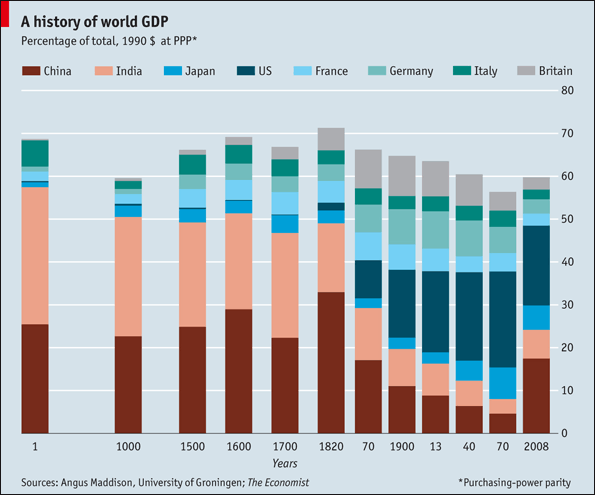
There has been some news this week about China overtaking Japan as the worlds second largest economy, and it is only a matter of time before they supplant the US.
The reason for this is quite evident in this excellent chart from the Economist. 
For centuries China and India had the worlds largest economies because they had the worlds largest populations and economies were largely agrarian.
The industrial revolution turned that math on its head, with the US and Europe taking the lead. But now that China and India are becoming more industrialized they will again become the worlds largest economies.
Simple math. 


Keep the faith and remember what John Wayne so famously stated, "Well Pilgrim, you gonna just lie there and bleed, or you going to get up?"

Be careful out there,

Chris Wiles

For prior Rockhaven Views visit:

This article contains the current opinions of the author but not necessarily those of the Rockhaven Capital Management.  The author’s opinions are subject to change without notice. This article is distributed for informational purposes only. Forecasts, estimates, and certain information contained herein are based upon proprietary research and should not be considered as investment advice or a recommendation of any particular security, strategy or investment product. Information contained herein has been obtained from sources believed to be reliable, but not guaranteed.
    

Friday, August 13, 2010

Supermodel Portfolio

Cheeseburger in paradise.
Heaven on earth with an onion slice.
Not too particular, not too precise.
I'm just a cheeseburger in paradise.

Cheeseburger in Paradise by Jimmy Buffett

Sometimes you need to get your hands dirty in the name of research. You know, down in the trenches, sand under the finger nails, old fashioned research. Well, that's exactly what I've been doing the last couple of weeks. I have been trying to construct a diversified high-yielding portfolio -- a "Supermodel" Portfolio. While our Global Tactical Asset Allocation Model Portfolio is our core all-weather portfolio, several of my clients, myself included, have expressed a desire, no a need, for more income. In a world where the Federal Reserve is battling the specter deflation via ZIRP (Zero Interest Rate Policy), many investors are seeking income alternatives other than collecting bottles and cans along the roadside. So after extensive Supermodel research I determined that I would have to make an on-site visit to the home of the legendary S.I. Supermodel Reunion ... the pink sand beaches of Harbour Island. After all, if you're going to construct a "Supermodel" Portfolio, what better place could there be for inspiration than the site chosen for one of the most famous supermodel photo-shoots ever. 


First logistics.
Harbour Island (aka Briland) is a speck of an island (3.5 miles long by 1.5 miles wide) in the Bahamas off of the coast of Eleuthera. Getting there from Pittsburgh entails a flight to Charlotte (like every flight out of the 'burgh), a connection to Nassau, another connection (via a much smaller plane) to North Eleuthera, a short taxi ride, and then a water taxi from Eleuthera to Harbour Island. There are no airports on Harbour Island, so even those of you with access to private jets will have to slum it a bit with the common folk on the water taxi. Of course those of you with private yachts can sail right over. 
The entire island is surrounded by a treacherous reef known as the "Devil's Backbone". Even experienced captains stop at Eleuthera to pick up a local pilot to help them navigate safely through. The beauty of this treacherous reef is that "No" cruise ships visit the island ... and that's exactly how the locals like it. In fact the locals are very protective. Development has been strictly limited and there are only a handful of boutique hotels and houses for rent. Idyllic is an apt description.
Harbour Island is one of the oldest settlements in the Bahamas, originally occupied by the Lucayan Indians who were enslaved by the Spanish in the 1500's. English puritans settled on the island in the 1600's and many English Loyalists moved there after the American Revolutionary War. Today the largest inhabitants seem to be free-range chickens and in particular roosters (my favorite t-shirt was "So Many Roosters, So Few Recipes). The architecture is very reminiscent of a quaint New England village. The Island is world renowned for its pink sand beach which is 3 miles long and 50 to 100 feet wide, it is simply the most beautiful beach that I have ever seen. Also, because of the reef right off shore, the water is exceptionally clear and calm, a snorkeling and swimming paradise.


Traveling on the island is almost entirely done via golf carts. Our first morning I ventured out in search of coffee and breakfast while the girls slept. I found out that the place for breakfast on the island is Arthur's Bakery. While Arthur's has a great selection of breakfast and lunch items (try the guava turnovers, lime tarts, and lobster omelets), it is also news and gossip central. Arthur is the quintessential island entrepreneur, and was a font of information on island happenings as well as the Bahamas in general.
While chatting with Arthur I found out that the biggest investment news in the Bahamas over the last several years is very similar to the investment news in most emerging markets...the Chinese. The Chinese have purchased and operate the airport in Freeport, and they've also built the largest container port in the world in Freeport. They are buying resorts and farm land throughout the Bahamas, and have filed for over 6,000 Chinese work permits. Arthur said that most people are enthusiastic to have the Chinese money entering the islands but are very leery of Chinese workers displacing Bahamian workers. He said that the Chinese are now the "go to" source for investment funds in the Bahamas.

Back to our "Supermodel". The keys to building a supermodel investment portfolio are very similar to those used to build a supermodel photo spread. Find some very appealing assets that will help you achieve your goals, while making sure you have enough diversity. As for our "Supermodel" High-Yield Portfolio I searched for a variety of high-yielding securities that would meet my goal of high current income while hopefully not being perfectly correlated to one another. My broad areas of interest fell into the following categories: High Yield Corporate Bonds, Mortgage REIT's, Royalty Trust's, Master Limited Partnerships, and Convertible Securities. Using individual securities, ETF's, and closed-end funds I was able to construct a fairly diversified portfolio with a current yield of about 9%. OK, 9% current yield in a world of 2.7% ten year Treasuries sounds appealing, but it should also send off warning alarms. Obviously yields that high mean that you are taking risk. Higher yielding corporate bonds and convertibles are lower quality securities, and lower quality securities are more volatile than higher quality securities. REIT's,  MLP's, and Royalty Trusts generally have higher yields because of various tax advantages at the corporate level, these tax advantages at the corporate level may increase tax complexity for individual investors. In other words this portfolio is not for the faint of heart, nor should it be used for a large portion of your assets (I'm starting with less than 5%). High reward, high risk, what would you expect from a "Supermodel"
If you think this "Supermodel" may be of interest to you please give me a call.

Overall, it was a fabulous couple of weeks of research. Rested, recharged, a few pounds heavier (Jimmy Buffett frequents Ma Ruby's for her Cheeseburger in Paradise whenever his yacht is in the area), with a new "Supermodel" Portfolio tucked under my arm. 


Be careful out there,


Chris Wiles

For prior Rockhaven Views visit:


This article contains the current opinions of the author but not necessarily those of the Rockhaven Capital Management.  The author’s opinions are subject to change without notice. This article is distributed for informational purposes only. Forecasts, estimates, and certain information contained herein are based upon proprietary research and should not be considered as investment advice or a recommendation of any particular security, strategy or investment product. Information contained herein has been obtained from sources believed to be reliable, but not guaranteed.


Saturday, July 31, 2010

Uncertainty Is Killing Me

"Uncertainty is killing me
And I'm certainly not asleep
Maybe I've gone far too deep
Maybe I'm just far too weak
And that's the last place I want to be, the last place"


July saw the stock market rally on the back of strong corporate earnings, and the bond market rally on fear of economic collapse. Can this dichotomy continue? Can corporate earnings continue to strengthen if the economy falls? What an unusual time, in fact you may call it "unusually unusual." In his recent testimony to Congress our esteemed Federal Reserve President, Ben Bernanke, called the economic outlook "unusually uncertain." While non-voting Fed President Richard Fisher said businesses are not committing to growth due to "unmanageable uncertainty."  And just yesterday voting Fed President James Bullard (a noted inflation hawk) stated that the Fed, "Must be prepared for a negative shock and be ready to expand the quantitative easing program through the purchases of Treasury securities." So the Fed, whose main job is to keep us all calm, is stating as calmly as possible, we're pretty certain that we are uncertain about this economic recovery, and since interest rates are already at zero we will probably seek to debase our currency again by buying a trillion or so of Treasury securities.
Yes, uncertainty is rampant, but the future is always uncertain. We live in a world where change is the norm. Our job is not to dwell in the past, but to live for today, and adapt for whatever tomorrow throws at us.
Investment management is really risk management, as the world changes the nature of risk changes. And since no one really knows what the outcomes of these changes may bring it is important to keep some powder dry for protection, as well as for those eventual opportunities. We may see protectionism emerge, or an increase in global unrest borne out of high unemployment, or even sovereign defaults on debt. We may also see none of the above. Good things can happen too. Whenever there are periods of high risk and uncertainty the performance correlation of most asset classes moves towards one, diversification becomes less useful, but opportunities arise. During periods of high risk, when nearly all asset classes move in tandem, we usually see the most lucrative opportunities emerge. We all must remain vigilant, but not blind to the opportunities. 
All of this uncertainty is not without a bright spot or two. First, we have record low 30 year mortgage rates of 4.59%, which is great if you are certain of your continued employment prospects. Second, the Fed has made it pretty clear that one of the causes of their uncertainty is the uncertain future of taxes, and that it would make a lot of sense to allow the Bush tax cuts to stay in place for at least another year. 

"Thousands were lost and maybe more
The question remains, "What is this for?"
Maybe it came unexpected
Maybe I'm left unprotected
And that's the last place I want to be, the last place"

Things were looking pretty bleak for equities in the first couple of days of July as the media and nearly all technicians pontificated on the "Death Cross". In technical speak the "Death Cross," or as I prefer the "Dark Cross," happens when a securities 50 day moving average crosses below it's 200 day moving average, signaling that the uptrend is broken and a new downtrend is on the way. It is said that Mr. Market has a very perverse sense of humor, and that any time the majority of investors believe something is going to happen he makes sure that it doesn't. That is exactly what happened in July, since as soon as the S&P 500's 50 day MA broke below it's 200 day MA, it reversed and rallied strongly, ending the month up  6.80%. Fortunately our indicators for the US equity market never quite broke down so we stayed invested and participated in the rally. For the year the S&P 500 is now down -0.17%. This rally was not the exclusive domaine of US equities, we also saw strong moves in international equities with EAFE up 11.61%, emerging markets up 10.21%, and international REITs up 10.01%. Most commodity indexes were up about 6%, but gold fell about -5.0%. 

The real story continues to be the Treasury market and it's rapidly disappearing yield. 2-Year Treasuries ended the month at a yield of 0.55%, while the 10-Year now yields 2.91%. You can get a 90 day jumbo CD to yield all of 40 basis points! Not only have yields plummeted in the treasury market, they have plunged in the corporate bond market (lowest in six years) and international fixed income markets as well. Our holdings in emerging market sovereign debt (EMB), and International developed market sovereign debt (IGOV) were up 4.05% and 5.52% respectively. The fixed income loser of the month was TIPS down -0.24%. 

Investment Considerations:
This week we had a couple of trades that reflect this dichotomy in the markets. First we went from neutral in emerging market equities back to bullish, and second we went from bearish in international developed market sovereign debt to neutral. This reduced our holdings in cash equivalents to 27.5%.

Where do we stand?
US Equities -- Neutral, but moving towards Bearish
Int'l Equities -- Bearish for EAFE and Bullish for emerging markets
US REITs -- Neutral 
Int'l REITs -- Bearish, but moving towards neutral
Gold -- Bullish, but moving towards neutral 
Commodities -- Bearish, but moving towards neutral
US Fixed Income -- Bullish, record highs and overbought
Int'l Fixed Income -- Neutral, but emerging market debt bullish
Cash Equivalents -- At 27.5%. Our 5% in Chinese Yuan getting a little lift. 


Be careful out there,

Chris Wiles

For prior Rockhaven Views visit:

This article contains the current opinions of the author but not necessarily those of the Rockhaven Capital Management.  The author’s opinions are subject to change without notice. This article is distributed for informational purposes only. Forecasts, estimates, and certain information contained herein are based upon proprietary research and should not be considered as investment advice or a recommendation of any particular security, strategy or investment product. Information contained herein has been obtained from sources believed to be reliable, but not guaranteed.
    

Friday, July 23, 2010

Gimme Shelter


Oh, see the storm is threatening
my very life today
if i don't get some shelter
yeah, i'm gonna fade away

"Gimme Shelter" by The Rolling Stones

Safe Money...Is There Such A Thing:

Most of my clients are a lot like me (scary thought, huh) they are just looking to preserve and protect their hard earned dollars from a world full of risks, in other words they're looking to "shelter" their money. This is exactly why I created Rockhaven, and have instituted our Global Tactical Asset Allocation program. The goal is simply to preserve and increase purchasing power over time. We use technical analysis to shift assets amongst nine separate investable markets, including cash. While this has been working admirably for the bulk of my assets (currently about 45%) I also have three other buckets where my wealth is "sheltered."
One, is simply a cash cushion. Cash as defined as money markets, checking, etc., that you feel comfortable holding. My cash holdings amount to about 15% of my net worth.
Two, is real estate (net of mortgages). My home and condo in the mountains account for about 20% of my net worth.
And Three, my municipal bond holdings, which make up the final 20%. 
Now there is no right or wrong mix, everyone has various levels of risk tolerance. Some may want more or less in cash, others may have much more in their homes, again there is no right or wrong number...we all have to find our own personal "shelter from the storm."
Back to Safe Money. Safety is a relative term, there is no such thing as risk free! All investments, even cash, have risk. Obviously cash/money market assets can be considered pretty safe, the biggest risk is inflation and the devaluation of the dollar. The other area I consider as pretty safe is my municipal bond portfolio. But not all municipal bonds are created equal, like all bonds they are only as good as the issuers ability to repay them. And obviously with the increased stress on many municipalities repayment risk has been on the rise. Municipal bonds predominately fall into two categories; general obligation, and revenue bonds. General obligation bonds are considered less risky because they are backed by the municipalities ability to tax. Revenue bonds are backed by the revenues generated by the issuer; utilities, parking fees, hospitals, etc.
I prefer owning municipal bonds outright as opposed to muni bond funds because, if interest rates rise over time, muni bond funds will fall in value while individual muni's will mature at par, and enable you to reinvest the proceeds at the new higher rates. 
In today's market, high quality Pennsylvania municipal bonds yield between 3.0% and 4.0%, depending on the maturity and issuer. If you live in PA these are double tax-exempt, PA and Federal. The PA tax rate is 3.07%, and most of you are probably paying 33% to 35% in Federal taxes (soon to be 36% to 39.6%). So a laddered (issues maturing in various years) portfolio of PA muni's with an after tax yield of 3.5% would equate to a taxable equivalent yield of between 5.5% and 6.1% (depending on your tax bracket). Not a bad return when two year treasuries yield 0.60% and the ten year yields 2.94%, before taxes!
While the Global Tactical Asset Allocation product is my main job, I recently created a laddered muni bond portfolio for a client at a nominal fee. If this is something that may be of interest to you please give me a call. "The floods is threatening, my very life today. Gimme, gimme shelter or I'm gonna fade away."

Lies Revisited-- My Readers Comments:

I had some very interesting comments from my readers regarding the White House's recently released YouTube video on the Dodd-Frank FinReg Bill (DRANK for short), I thought I would share a few (the ones that weren't profane):  In case you missed it, view with caution ... What Wall Street Reform Means for You brought to you by The Obama White House.

--Thanks Chris, I feel dumber for having watched it. The sheer arrogance of this White House amazes me!

--Is it me, or is it all of us Neanderthals that he insulted!    2:33 Add to queueAdded to queue All Geico Cavemen Commercial435,454 viewsri4162


--The White House is walking a very fine line. They have been treating us like we are totally incapable of taking care of ourselves, and now they step it up a notch to full retard...and as we all know "Full Retard" doesn't win you the Oscar, it just makes you look stupid. View Clip Full Retard Scene

And my favorite:
--You know, when flipping houses was like totally cool, I don't remember lots of forms.  They just handed me a mirror and said, "blow on it."  I didn't see any blow on it, so I laughed and got it all fogged up.  I said sorry, cuz now the mirror was damp and liners get gunky on damp mirrors, but they thanked me and gave me a set of keys.  Is it gonna be easier than that now that the government cares about me?


Computational Knowledge Engine:
If knowledge is power...consider yourself more powerful!
This is one of the most amazing knowledge sites I've ever seen, please share!


Be careful out there,

Chris Wiles

This article contains the current opinions of the author but not necessarily those of the Rockhaven Capital Management.  The author’s opinions are subject to change without notice. This article is distributed for informational purposes only. Forecasts, estimates, and certain information contained herein are based upon proprietary research and should not be considered as investment advice or a recommendation of any particular security, strategy or investment product. Information contained herein has been obtained from sources believed to be reliable, but not guaranteed.

Thursday, July 22, 2010

Lies: Part II

Sometimes I can't even believe it when I see it with my own eyes!
The White House just put this video out on You Tube to make sure you understand that everything bad that happened in the last decade was caused by greedy bankers/casino operators, and had nothing to do with stupid consumers or politicians. And that the new FinReg Bill will make sure that this will never happen again. Banks will be smaller (tell that to JP Morgan, Bank of America, or Wells Fargo), and we will never have to bail them out again. Again, no mention of the $3.7 trillion or the ongoing billions flowing into Fannie and Freddie. Lets not complicate the story with facts. 
Sadly your tax dollars paid for the video.


Be careful out there,

Chris Wiles

This article contains the current opinions of the author but not necessarily those of the Rockhaven Capital Management.  The author’s opinions are subject to change without notice. This article is distributed for informational purposes only. Forecasts, estimates, and certain information contained herein are based upon proprietary research and should not be considered as investment advice or a recommendation of any particular security, strategy or investment product. Information contained herein has been obtained from sources believed to be reliable, but not guaranteed.

Lies


Lies, dripping off your mouth like dirt
Lies, lies in every step you walk
Lies, whispered sweetly in my ear
Lies, how do I get out of here?
Why, why you have to be so cruel?
Lies, lies, lies I ain't such a fool! 


Lies, whispered sweetly in my ear. Today I happened to catch our President signing the 2300 page nightmare of a bill called the "Dodd-Frank Wall Street Reform and Consumer Protection Act". And as he is wont to do, states emphatically that, "This reform will help foster innovation, not hamper it." And my favorite, "Finally, because of this law, the American people will never again be asked to foot the bill for Wall Street's mistakes. There will be no more taxpayer-funded bailouts. Period." 
Wow, so if I understand my President correctly (after all he did say, "Period") the government's (i.e., yours and mine) support of bankrupt Freddie and Fannie ends today!
Well, not so fast. Why, why do you have to be so cruel? Later in the day I caught a great interview with Neil M. Barofsky, the Special Inspector General for the Troubled Asset Relief Program ("SIGTARP"). SIGTARP and Mr. Barofsky's job is to conduct and supervise audits of the TARP programs to protect the interests of the American taxpayers. A very noble job indeed. In his interview on the Dylan Ratigan Show he states, "When I ask people if the amount of Federal support for the nation's financial system has increased or decreased over the last year, their unanimous answer is, decreased." Unfortunately nothing can be further from the truth, taxpayer support has grown by 23% over the last year from $3.0 trillion to $3.7 trillion! Mr. Barofsky is screaming the truth, but is anyone in Washington listening? The simple fact, that the President refuses to acknowledge, is that the new Fin-Reg bill does nothing to stop this robbery. Lies and taxpayer funded bailouts continue. 
Here is the link to his interview:

White House continues bailout bonanza
http://www.msnbc.msn.com/id/32450072/vp/38349626#38349626

And here is an excerpt from his just released report. The full report can be found here:
Executive Summary
"An examination of the broader context demonstrates that the overall Governmental efforts to stabilize the economy have not diminished. Indeed, the current outstanding balance of overall Federal support for the nation’s financial system, in actual expenditures and guarantees, including ongoing initiatives run by the Federal Reserve System (“Federal Reserve”), the Federal Deposit Insurance Corporation (“FDIC”), the Department of Treasury (“Treasury”), the U.S. Department of Housing and Urban Development (“HUD”), and other Federal agencies, has actually increased more than 23% over the past year, from approximately $3.0 trillion to $3.7 trillion — the equivalent of a fully deployed TARP program, largely without additional Congressional action — even as the banking crisis has, by most measures, abated from its most acute phases. This increase has focused primarily on additional Government support of the still-distressed housing market and the financial institutions whose fate has been so closely tied to it throughout this crisis, with additional support of asset prices and low interest rates (predominantly via the Government’s expanded role in the mortgage market) through increases in HUD programs and support of Federal National Mortgage Association (“Fannie Mae”) and Federal Home Loan Mortgage Corporation (“Freddie Mac”)  more than offsetting the decline in amounts outstanding under TARP and in the winding down of several Federal Reserve liquidity programs." 

On a much more uplifting note, a website devoted to the truth:

Computational Knowledge Engine:
If knowledge is power...consider yourself more powerful!
This is one of the most amazing knowledge sites I've ever seen, please share!


Be careful out there,

Chris Wiles

This article contains the current opinions of the author but not necessarily those of the Rockhaven Capital Management.  The author’s opinions are subject to change without notice. This article is distributed for informational purposes only. Forecasts, estimates, and certain information contained herein are based upon proprietary research and should not be considered as investment advice or a recommendation of any particular security, strategy or investment product. Information contained herein has been obtained from sources believed to be reliable, but not guaranteed.