Thursday, September 16, 2010

Rock On Gold Dust Woman


"So rock on, ancient queen
Follow those who pale in your shadows
They say rulers,
They make bad lovers
You'd better put your kingdom up for sale
Well you'd better sell it, sell it "
"Gold Dust Woman" by Stevie Nicks

With gold hitting a new high in dollar terms of $1,275, I thought it was an appropriate time to trot out an old article (circa 1967) written by none other that Alan Greenspan, former Chairman of the Federal Reserve. The reason this article came to mind was John Paulson's (the multi-billion dollar hedge fund manager) recent letter to investors reminding them that Alan Greenspan now works for them, and that Greenspan's currency views are a major reason why Paulson's $30 billion hedge funds have over 25% devoted to gold. An excerpt of the letter:
"Lastly, and perhaps most importantly, from a monetary policy perspective in developing an ability to forecast the timing and future price of gold we believe we have an unparalleled team. Former Federal Reserve Chairman Alan Greenspan has been extremely helpful to us in understanding the relationship between the monetary base, the money supply, inflation and gold prices."
One of our cardinal rules here at Rockhaven is to be in harmony with the markets, and a big part of that is to observe where money is heading and get in front of it. All of our client accounts have had at least 10% invested in gold. Numerous people talk about gold being in a bubble, they point to the TV ads, and the gold exchanges at the Mall, but the truth is very few people actually invest in gold. How much gold do you own as a percentage of your net worth? How much do you think the big bank trust departments have invested in gold (zero to not much)? Everything you own is valued in fiat currencies, mostly US dollars, is that diversification? If the biggest risk we face as investors is the rapid devaluation of the US dollar, isn't gold a way to hedge that risk?
I've always found Greenspan to be an interesting character, for a money geek. An accomplished saxophonist, he dropped out of Juilliard to join a jazz band, but soon grew tired of starving and went back to school to study economics. In the 1950's he became good friends with Ayn Rand, who stood next to him in 1974 when President Ford swore him in as Chair of the Council of Economic Advisors. He dated Barbara Walters in the late 1970's, and in 1984, at the age of 58, he began dating 38 year old journalist Andrea Mitchell. They were married in 1997 by Supreme Court Justice Ruth Bader Ginsburg. 
It appears that since leaving the highly politicized world of the Fed, Greenspan has reverted to his old libertarian beliefs. Here are a couple of his quotes from a recent investment conference in New York:
"What is fascinating is the extent to which gold still holds reign over the financial system as the ultimate source of payment." And "Rising prices of precious metals and other commodities are an indication of a very early stage of an endeavor to move away from paper currencies." 
Here is a copy of his 1967 article:


GOLD AND ECONOMIC FREEDOM

An almost hysterical antagonism toward the gold standard is one issue which unites statists of all persuasions. They seem to sense-perhaps more clearly and subtly than many consistent defenders of laissez-faire -- that gold and economic freedom are inseparable, that the gold standard is an instrument of laissez-faire and that each implies and requires the other.

In order to understand the source of their antagonism, it is necessary first to understand the specific role of gold in a free society.

Money is the common denominator of all economic transactions. It is that commodity which serves as a medium of exchange, is universally acceptable to all participants in an exchange economy as payment for their goods or services, and can, therefore, be used as a standard of market value and as a store of value, i.e., as a means of saving.

The existence of such a commodity is a precondition of a division of labor economy. If men did not have some commodity of objective value which was generally acceptable as money, they would have to resort to primitive barter or be forced to live on self-sufficient farms and forgo the inestimable advantages of specialization. If men had no means to store value, i.e., to save, neither long-range planning nor exchange would be possible.

What medium of exchange will be acceptable to all participants in an economy is not determined arbitrarily. First, the medium of exchange should be durable. In a primitive society of meager wealth, wheat might be sufficiently durable to serve as a medium, since all exchanges would occur only during and immediately after the harvest, leaving no value-surplus to store. But where store-of-value considerations are important, as they are in richer, more civilized societies, the medium of exchange must be a durable commodity, usually a metal. A metal is generally chosen because it is homogeneous and divisible: every unit is the same as every other and it can be blended or formed in any quantity. Precious jewels, for example, are neither homogeneous nor divisible. More important, the commodity chosen as a medium must be a luxury. Human desires for luxuries are unlimited and, therefore, luxury goods are always in demand and will always be acceptable. Wheat is a luxury in underfed civilizations, but not in a prosperous society. Cigarettes ordinarily would not serve as money, but they did in post-World War II Europe where they were considered a luxury. The term "luxury good" implies scarcity and high unit value. Having a high unit value, such a good is easily portable; for instance, an ounce of gold is worth a half-ton of pig iron.

In the early stages of a developing money economy, several media of exchange might be used, since a wide variety of commodities would fulfill the foregoing conditions. However, one of the commodities will gradually displace all others, by being more widely acceptable. Preferences on what to hold as a store of value, will shift to the most widely acceptable commodity, which, in turn, will make it still more acceptable. The shift is progressive until that commodity becomes the sole medium of exchange. The use of a single medium is highly advantageous for the same reasons that a money economy is superior to a barter economy: it makes exchanges possible on an incalculably wider scale.

Whether the single medium is gold, silver, seashells, cattle, or tobacco is optional, depending on the context and development of a given economy. In fact, all have been employed, at various times, as media of exchange. Even in the present century, two major commodities, gold and silver, have been used as international media of exchange, with gold becoming the predominant one. Gold, having both artistic and functional uses and being relatively scarce, has significant advantages over all other media of exchange. Since the beginning of World War I, it has been virtually the sole international standard of exchange. If all goods and services were to be paid for in gold, large payments would be difficult to execute and this would tend to limit the extent of a society's divisions of labor and specialization. Thus a logical extension of the creation of a medium of exchange is the development of a banking system and credit instruments (bank notes and deposits) which act as a substitute for, but are convertible into, gold.

A free banking system based on gold is able to extend credit and thus to create bank notes (currency) and deposits, according to the production requirements of the economy. Individual owners of gold are induced, by payments of interest, to deposit their gold in a bank (against which they can draw checks). But since it is rarely the case that all depositors want to withdraw all their gold at the same time, the banker need keep only a fraction of his total deposits in gold as reserves. This enables the banker to loan out more than the amount of his gold deposits (which means that he holds claims to gold rather than gold as security of his deposits). But the amount of loans which he can afford to make is not arbitrary: he has to gauge it in relation to his reserves and to the status of his investments.

When banks loan money to finance productive and profitable endeavors, the loans are paid off rapidly and bank credit continues to be generally available. But when the business ventures financed by bank credit are less profitable and slow to pay off, bankers soon find that their loans outstanding are excessive relative to their gold reserves, and they begin to curtail new lending, usually by charging higher interest rates. This tends to restrict the financing of new ventures and requires the existing borrowers to improve their profitability before they can obtain credit for further expansion. Thus, under the gold standard, a free banking system stands as the protector of an economy's stability and balanced growth.

When gold is accepted as the medium of exchange by most or all nations, an unhampered free international gold standard serves to foster a world-wide division of labor and the broadest international trade. Even though the units of exchange (the dollar, the pound, the franc, etc.) differ from country to country, when all are defined in terms of gold the economies of the different countries act as one -- so long as there are no restraints on trade or on the movement of capital. Credit, interest rates, and prices tend to follow similar patterns in all countries. For example, if banks in one country extend credit too liberally, interest rates in that country will tend to fall, inducing depositors to shift their gold to higher-interest paying banks in other countries. This will immediately cause a shortage of bank reserves in the "easy money" country, inducing tighter credit standards and a return to competitively higher interest rates again.
A fully free banking system and fully consistent gold standard have not as yet been achieved. But prior to World War I, the banking system in the United States (and in most of the world) was based on gold and even though governments intervened occasionally, banking was more free than controlled. Periodically, as a result of overly rapid credit expansion, banks became loaned up to the limit of their gold reserves, interest rates rose sharply, new credit was cut off, and the economy went into a sharp, but short-lived recession. (Compared with the depressions of 1920 and 1932, the pre-World War I business declines were mild indeed.) It was limited gold reserves that stopped the unbalanced expansions of business activity, before they could develop into the post-World War I type of disaster. The readjustment periods were short and the economies quickly reestablished a sound basis to resume expansion.

But the process of cure was misdiagnosed as the disease: if shortage of bank reserves was causing a business decline-argued economic interventionists -- why not find a way of supplying increased reserves to the banks so they never need be short! If banks can continue to loan money indefinitely -- it was claimed -- there need never be any slumps in business. And so the Federal Reserve System was organized in 1913. It consisted of twelve regional Federal Reserve banks nominally owned by private bankers, but in fact government sponsored, controlled, and supported. Credit extended by these banks is in practice (though not legally) backed by the taxing power of the federal government. Technically, we remained on the gold standard; individuals were still free to own gold, and gold continued to be used as bank reserves. But now, in addition to gold, credit extended by the Federal Reserve banks ("paper reserves") could serve as legal tender to pay depositors.

When business in the United States underwent a mild contraction in 1927, the Federal Reserve created more paper reserves in the hope of forestalling any possible bank reserve shortage. More disastrous, however, was the Federal Reserve's attempt to assist Great Britain who had been losing gold to us because the Bank of England refused to allow interest rates to rise when market forces dictated (it was politically unpalatable). The reasoning of the authorities involved was as follows: if the Federal Reserve pumped excessive paper reserves into American banks, interest rates in the United States would fall to a level comparable with those in Great Britain; this would act to stop Britain's gold loss and avoid the political embarrassment of having to raise interest rates.

The "Fed" succeeded; it stopped the gold loss, but it nearly destroyed the economies of the world in the process. The excess credit which the Fed pumped into the economy spilled over into the stock market -- triggering a fantastic speculative boom. Belatedly, Federal Reserve officials attempted to sop up the excess reserves and finally succeeded in braking the boom. But it was too late: by 1929 the speculative imbalances had become so overwhelming that the attempt precipitated a sharp retrenching and a consequent demoralizing of business confidence. As a result, the American economy collapsed. Great Britain fared even worse, and rather than absorb the full consequences of her previous folly, she abandoned the gold standard completely in 1931, tearing asunder what remained of the fabric of confidence and inducing a world-wide series of bank failures. The world economies plunged into the Great Depression of the 1930's.
With a logic reminiscent of a generation earlier, statists argued that the gold standard was largely to blame for the credit debacle which led to the Great Depression. If the gold standard had not existed, they argued, Britain's abandonment of gold payments in 1931 would not have caused the failure of banks all over the world. (The irony was that since 1913, we had been, not on a gold standard, but on what may be termed "a mixed gold standard"; yet it is gold that took the blame.) But the opposition to the gold standard in any form -- from a growing number of welfare-state advocates -- was prompted by a much subtler insight: the realization that the gold standard is incompatible with chronic deficit spending (the hallmark of the welfare state). Stripped of its academic jargon, the welfare state is nothing more than a mechanism by which governments confiscate the wealth of the productive members of a society to support a wide variety of welfare schemes. A substantial part of the confiscation is effected by taxation. But the welfare statists were quick to recognize that if they wished to retain political power, the amount of taxation had to be limited and they had to resort to programs of massive deficit spending, i.e., they had to borrow money, by issuing government bonds, to finance welfare expenditures on a large scale.

Under a gold standard, the amount of credit that an economy can support is determined by the economy's tangible assets, since every credit instrument is ultimately a claim on some tangible asset. But government bonds are not backed by tangible wealth, only by the government's promise to pay out of future tax revenues, and cannot easily be absorbed by the financial markets. A large volume of new government bonds can be sold to the public only at progressively higher interest rates. Thus, government deficit spending under a gold standard is severely limited. The abandonment of the gold standard made it possible for the welfare statists to use the banking system as a means to an unlimited expansion of credit. They have created paper reserves in the form of government bonds which -- through a complex series of steps -- the banks accept in place of tangible assets and treat as if they were an actual deposit, i.e., as the equivalent of what was formerly a deposit of gold. The holder of a government bond or of a bank deposit created by paper reserves believes that he has a valid claim on a real asset. But the fact is that there are now more claims outstanding than real assets. The law of supply and demand is not to be conned. As the supply of money (of claims) increases relative to the supply of tangible assets in the economy, prices must eventually rise. Thus the earnings saved by the productive members of the society lose value in terms of goods. When the economy's books are finally balanced, one finds that this loss in value represents the goods purchased by the government for welfare or other purposes with the money proceeds of the government bonds financed by bank credit expansion.

In the absence of the gold standard, there is no way to protect savings from confiscation through inflation. There is no safe store of value. If there were, the government would have to make its holding illegal, as was done in the case of gold. If everyone decided, for example, to convert all his bank deposits to silver or copper or any other good, and thereafter declined to accept checks as payment for goods, bank deposits would lose their purchasing power and government-created bank credit would be worthless as a claim on goods. The financial policy of the welfare state requires that there be no way for the owners of wealth to protect themselves.

This is the shabby secret of the welfare statists' tirades against gold. Deficit spending is simply a scheme for the confiscation of wealth. Gold stands in the way of this insidious process. It stands as a protector of property rights. If one grasps this, one has no difficulty in understanding the statists' antagonism toward the gold standard.

--Alan Greenspan
1967

"Did she make you cry
Make you break down
Shatter your illusions of love
Is it over now--do you know how
Pick up the pieces and go home."
 It's The Spending Stupid:
I'm not sure the folks in DC fully understand the angst of the American public, but I think it can be summed up nicely as "It's the spending, stupid."
The WSJ just reported that the percentage of American households receiving some form of government benefits (wealth transfers) has risen from 29.6% in 1983 to 44.4% in 2008 ... nearly half the population! In the meantime the percentage of American households not paying federal income taxes has also grown to 45% in 2010, from 39% in 2005! So we have nearly half the people getting checks from the government, and an increasingly smaller portion of the population paying for it. Even the mathematically challenged in DC should be able to realize that these trends can't continue much longer. The math doesn't work.

Be careful out there, and keep the light's on,


Chris Wiles

For prior Rockhaven Views visit:


This article contains the current opinions of the author but not necessarily those of the Rockhaven Capital Management.  The author’s opinions are subject to change without notice. This article is distributed for informational purposes only. Forecasts, estimates, and certain information contained herein are based upon proprietary research and should not be considered as investment advice or a recommendation of any particular security, strategy or investment product. Information contained herein has been obtained from sources believed to be reliable, but not guaranteed.
    

Monday, September 13, 2010

There's A Monster Living Under My Bed


Hey now, all you sinners
Put your lights on, put your lights on
Hey now, all you children
Leave your lights on, you better leave your lights on

Because there's a monster living under my bed
Whispering in my ear
There's an angel, with a hand on my head
She say's I've got nothing to fear 

"Put Your Lights On" by Santana 

I worry about monsters. My job is to worry. I even worry about things that I have no control over. Some say I should chill (chillax, my daughters say ) , but its just not in my nature.
I believe that as investment managers we should worry about everything, things that we can control and things that we can't control, even those that we can't imagine.
We need to "Put Our Light's On" and keep them on, for only by shedding light on potential monsters can we hope to protect ourselves.
The monster whispering in my ear of late is very scary. So scary that both Dennis Blair, Head of US Intelligence, and Admiral Mullen, Chairman of the Joint Chiefs of Staff, agree that it is the biggest single threat to our national security.
What is this monster that strikes fear in the hearts of our military? Is it Iran, the Taliban, North Korea, or Hezbollah? No, this monster is our National Debt. I know what you are saying, "How can something as soft and fuzzy as a debt monster scare the leaders of the worlds most powerful military?" Well, as Admiral Mullen says, "our national debt has grown to such a level that by 2013 the annual interest alone will be $600 billion, which is more than Pentagon spending." 
While this monster is huge, its size is not really the scary part. No, the scary part is the insidious makeup of this monster, and who controls it.
You see, of the total $8.3 trillion in national debt more than 60% of it ($5.2 trillion) comes due in the next three years. The current weighted average cost of this short-term debt is 1.21%, but with ten year treasuries now yielding 2.77%, we could be faced with an additional interest rate expense of $133 billion annually. While the sheer magnitude of the numbers and the refinancing risk are pretty scary, what really keeps our military leaders awake at night is who controls this monster.
In the United States we have placed our continuing political solvency in the hands of the Federal Reserve, and we have greatly increased their power of late. This in and of itself is not the risk, the risk arises from the fact that the Fed has exposed itself to an incredible degree of vulnerability by telegraphing its positions and asset support mechanisms. In the cut-throat world of international finance, showing your opponent all of your cards is usually a very quick way to insolvency. What worries our leaders is that if you take down the Fed, you take down the USA! Every Treasury auction brings with it the fear that buyers may not show up. Is it hard to imagine a day when the Chinese or the Russians decide not to participate in our Treasury auctions? It wasn't all that long ago that we bankrupted the Russian economy by outspending them in the Cold War. Now of course naysayers (angels) are quick to point out that since the Chinese and Russians own huge amounts of our dollar denominated paper they would never consciously seek to bring down the US via a failed auction. That our economies are so intertwined, that a depression in the US would cause them as much or more pain at home. "There's an angel, with a hand on my head, she say's I've got nothing to fear." 
Now that's all well and good, but forgive me if I agree with our military leaders in not totally trusting everyone; especially those who have developed missiles and lasers to attack satellites, and are constantly launching cyber attacks on our internet infrastructure. The risk is very real, we are strung-out debt junkies, reliant on the kindness of our foreign pushers to keep stringing us along. Not the strongest position for a nation to be in.

As US based investors, how do we protect our wealth from this risk? Not easily. First, as US citizens we can try to elect politicians that understand the nature of this threat, and who have the nerve to take the harsh steps necessary to wean us off the debt drug.
Second, we need to think globally with our portfolios. Owning stocks, bonds, and real estate outside of the US. Owning gold, and even foreign currencies like the Chinese Yuan.
Diversification and tactical asset allocation can help, but they only mitigate the potential damage. No, the only cure is to banish the debt monster, and remove the threat forever. "Leave your lights on, you better leave your lights on."

Speaking of Debt Monsters and Debt Junkies
The attached is a great article by Michael Lewis for Vanity Fair titled "Beware Of Greeks Bearing Bonds", enjoy: 


A Meal To Die For
I love America, and our willingness to flaunt conventional wisdom in order to embrace our personal freedoms.
A great example of Americans embracing their personal freedom is Bill Geist's visit to the Heart Attack Grill, truly enjoyable: 


Be careful out there, and keep the light's on,


Chris Wiles

For prior Rockhaven Views visit:


This article contains the current opinions of the author but not necessarily those of the Rockhaven Capital Management.  The author’s opinions are subject to change without notice. This article is distributed for informational purposes only. Forecasts, estimates, and certain information contained herein are based upon proprietary research and should not be considered as investment advice or a recommendation of any particular security, strategy or investment product. Information contained herein has been obtained from sources believed to be reliable, but not guaranteed.
    

Friday, September 3, 2010

Bye-Bye Miss American Pie

A long, long time ago...
I can still remember
How that music used to make me smile.
And I knew if I had my chance
That I could make those people dance
And, maybe, they’d be happy for a while.


American Pie by Don McLean

For most of my 25 year career as a professional money manager I practiced various forms of fundamental analysis. You know, picking stocks based on "fundamentals," such as; sales growth, earnings growth, balance sheet strength, management quality, and valuation. Variations of this fundamental approach to stock picking has served many managers very well over the last seventy years, but in the last decade it was often lacking, "Now for 10 years we've been on our own". There were always periods where fundamentals didn't work, generally when one sector or another was experiencing a bubble (think, nifty fifty in the '60's, energy in the '70's, or technology in the '90's), but since the early 2000's something has clearly changed. 

Over the years I've had many frustrating conversations with my peers trying to figure out why being a fundamental analyst was failing us. We never had a precise answer, but we did have some theories. One was the advent of sector funds and sector ETF's. With the advent of sector funds we noticed a marked increase in the correlation amongst stocks in that sector. When Pepsi moved up or down, Coke was most likely moving in tandem. The correlation among stocks in specific sectors grew closer and closer to 1.00. It often didn't matter if the fundamentals or valuations were better at Pepsi or Coke, they both moved in tandem. 

Now clearly there were outliers. There are always company specific events that may separate one company from another (i.e. BP with the rig explosion, or on the positive side Apple with the iEverything), but these are becoming rarer and rarer to find.

What this means for fundamental portfolio managers is that the opportunities to add value (or Alpha in quant speak) are becoming fewer and fewer. This fact can be readily observed by looking at the performance convergence among active managers. "I can't remember if I cried..."

Another area of concern was the massive increase in trading being done by Quant shops, or High-frequency Trading (HFT) operations. Ten years ago we were aware that trading based on computer algorithms accounted for nearly 50% of daily trading volume in US markets. Since then the technology has accelerated to the point where HFT platforms have ramped up speeds from trades per second, to trades per millisecond, to trades per microsecond (that's one-millionth of a second). These trades now account for more than 80% of daily total trading volume. "Oh, and while the King was looking down, the Jester stole his thorny crown." One CEO of a High-frequency trading firm stated that their longest duration holding period for a stock was eleven seconds, and he considered that rare and unacceptably long. These trades have absolutely nothing to do with corporate fundamentals. Go back to May 6, how can Procter & Gamble be trading at $62 one minute and $39 the next? It wasn't fundamentals. Attached is an excellent article from International Economy magazine by Harald Malmgren and Mark Stys on HFT and "The Marginalizing of the Individual Investor." http://www.international-economy.com/TIE_Su10_MalmgrenStys.pdf

This divergence between fundamentals and reality is one of the main reasons I set up Rockhaven Capital Management the way I did, "singin' bye-bye Miss American Pie". At Rockhaven our goal is to preserve and grow our assets, it's not to try and find an undervalued stock and hope that someday it may trade to our perceived fair value (the deck is stacked against you if that's your game). Our job is to allocate assets broadly around the globe and be in harmony with what is working. The most important part of the job is the protection part, constantly monitoring risks and managing them. 

I believe that High-frequency Trading is a risk, potentially a very large risk, that is undermining what markets were traditionally designed to do...allow companies to raise capital and allow investors to participate in a companies potential growth, the proverbial "American Pie". Hopefully the exchanges and regulators will be able to mitigate this risk, but we as investors must remain constantly vigilant, or "this will be the day that I die." 

Investment Considerations:
After a tough August (S&P 500 down 4.50%) we've seen a very strong bounce in the first couple of days of September (S&P 500 up 5%+). Trends, momentum, and seasonality all point to lower equity prices, but maybe the short-term bearish sentiment had run a bit too far. The economic numbers out this week were not rosy, but they were better than the dire expectations. The real wildcard for September and October is how aggressive the Fed will be with Quantitative Easing II (QEII), and more importantly what may come out of a very panicked White House prior to the elections. With the administration facing third and very long, with the clock rapidly ticking towards November, it would not be surprising to see a hail Mary proposal to extend the Bush tax cuts, or implement some type of payroll tax relief. 
Even though we are firmly in a secular bear market, there can be some very strong cyclical bounces, especially of the government engineered type. 

Where do we stand?
US Equities -- Neutral, but very close to moving into Bearish territory
Int'l Equities -- Neutral for EAFE and Bullish for emerging markets
US REITs -- Bullish 
Int'l REITs -- Neutral, and moving towards Bullish
Gold -- Bullish 
Commodities -- Neutral, but moving towards Bullish
US Fixed Income -- Bullish, record highs and overbought
Int'l Fixed Income -- Bullish, and emerging market debt Bullish
Cash Equivalents -- At 16.5%. 


A Fair Tax Plan:
Wayne Angell, former Governor of the Federal Reserve Board, in conjunction with several dozen economists have put together a very compelling plan to get this country on the right track. They call it a Fair Tax Plan, and all it does is eliminate all personal taxes, corporate taxes, and the IRS, and replaces them with a national sales tax (also known as a consumption tax). 
It may be wishful thinking, but its at least nice to see something like this proposed by some very respected thinkers. 

The Student Loan Scheme:
For those of you with college students heading back to school please take a look at this excellent graphic from Jess Bachman. 
Student loans have now taken over the number two spot in Americas debt bubble (behind mortgages but ahead of credit cards).


Be careful out there,

Chris Wiles

For prior Rockhaven Views visit:

This article contains the current opinions of the author but not necessarily those of the Rockhaven Capital Management.  The author’s opinions are subject to change without notice. This article is distributed for informational purposes only. Forecasts, estimates, and certain information contained herein are based upon proprietary research and should not be considered as investment advice or a recommendation of any particular security, strategy or investment product. Information contained herein has been obtained from sources believed to be reliable, but not guaranteed.
    

Tuesday, August 24, 2010

"Dad, Can I Have Some Money, I Need..."

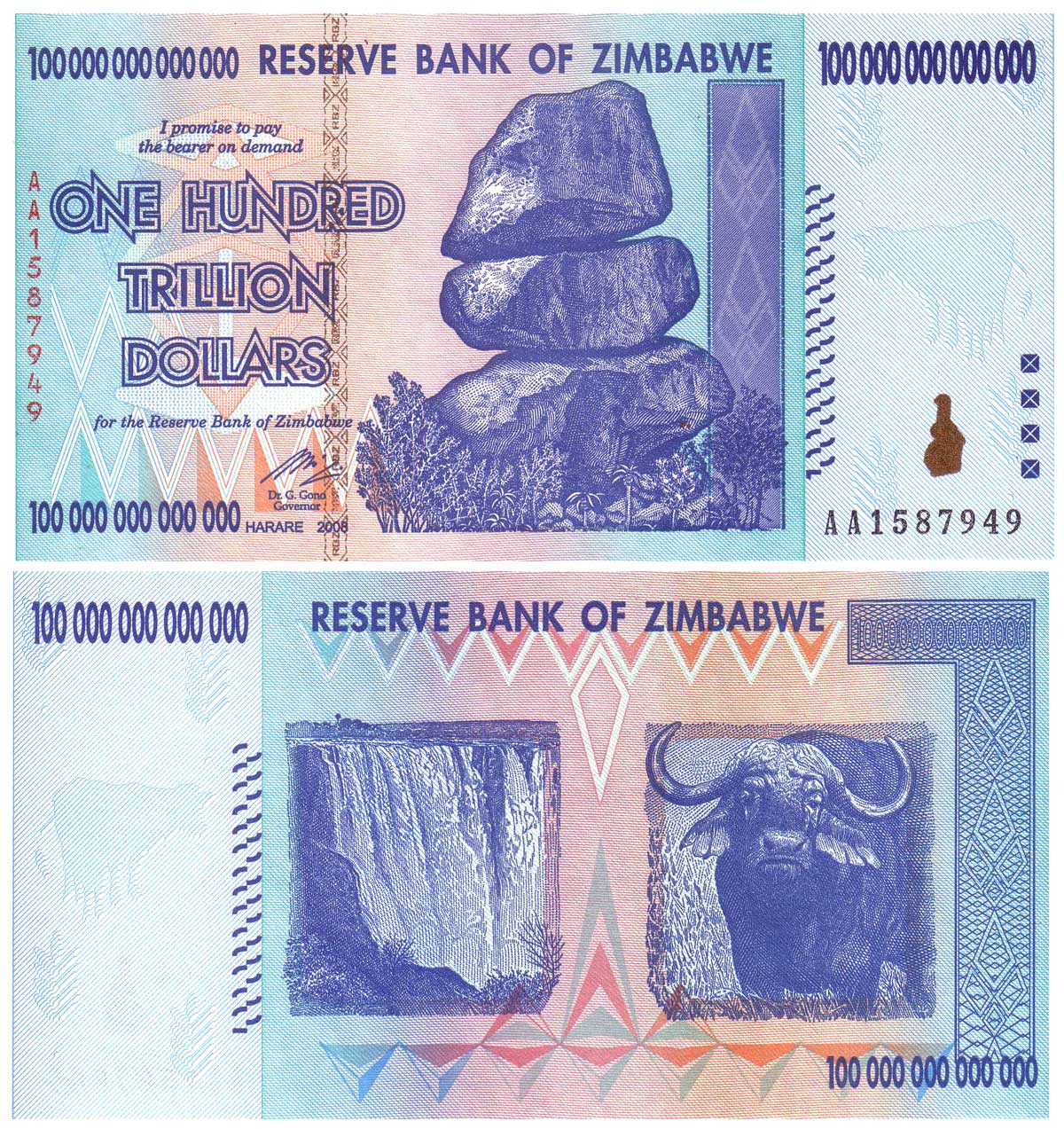
I’m willing to bet that nearly every parent has heard these words at one time or another, especially as the kids head back to school. Unfortunately for my girls, when they recently asked this question, I was admiring my newest acquisition, a freshly minted One Hundred Trillion Dollar note from Zimbabwe (The largest denomination note ever printed with the zero’s on it, all 14 of them). I had just paid $8 dollars for it on Amazon.

I asked the girls what they thought this “money” was worth?  My youngest eyes got a little wider as she asked, “Is that like real?” I said, “it is very real, what do you think it is worth?” My oldest daughter, having played these games a few too many times, rolled her eyes and said, “whatever I can get for it.” Correct, money is only worth what you can purchase with it. You see the poor people of Zimbabwe lived in a war torn country, with a very corrupt government, that just kept on printing more and more money to pay for things. Eventually they printed so much money that it wasn’t worth anything.

Prices for basic goods, like milk and bread, were doubling every day. Soon the sellers of these goods wouldn’t put them out on the shelves, and instead of accept the government’s paper money, people would just trade goods with each other.  My $100 trillion dollar note was introduced in January 2009, and just two weeks later Zimbabwe abandoned their currency and converted their economy to US dollars.

So what’s my $100 trillion dollar note worth; eight dollars to a currency collector, or zero to someone trying to spend it.

“That’s pretty cool Dad, but we still need some “real” money.”

 “Real money” I said, “you mean like this?” Pulling out a fresh One Hundred Dollar bill.

“Yeah, that will do,” they said, while reaching for it. “Woo not so fast, is this “real” money?” “Yeah” they said in unison. “How do you know”, I asked? “Because, if we take it to the store we can buy $100 worth of stuff,” Rachel answered. “True enough,” I said, “but why is it worth that?” “Because that’s what the government says it’s worth”, says Lauren. 

“Well done, but why is the US note worth $100, and the Zimbabwe note worthless?”

I could tell that they were tiring of my questioning so I answered this one, “because we trust the US government, and no one trusts the Zimbabwe government, at least for now.” “You see all money today is based on faith, faith in others to accept it, and faith that the issuing government won’t devalue it.”

“Wow that’s like scary, you mean its like all just based on trust and nothing real?” “That’s right, but it wasn’t always that way, money used to be backed by stuff like gold or silver, this faith based money is a rather new phenomenon.”

“Well, we still need some money Dad.”

“OK, OK, but first let me tell you a little story about money.”

A long, long time ago (when I was your age), currencies were backed by gold. In other words, you could exchange your paper for an equal amount of the metal. This was the way the world worked, in varying degrees, for thousands of years. Paper money, or promissory notes, could be exchanged for gold or silver. And in many cases coins were actually made out of precious metals. This gold backed currency system worked well during most of history. When governments usually got into trouble it was because they were printing more currency than they had gold to back it. This was generally done to support their military endeavors. 

Our US system started to unravel in earnest during the 1960's when an excessive amount of money was printed to help finance the Vietnam war and our struggling economy. At the time the price of gold was fixed at $35 per ounce, and any government could go to the gold window and exchange their dollars for gold. During this period foreign governments accumulated large quantities of dollars, far exceeding our governments stock of gold. The proverbial (you know what) hit the fan in August 1971, when the British ambassador turned up at the Treasury Department to request that $3 billion US dollars be converted into gold. The very next week President Nixon announced to the world that the gold window was now closed and the United States was no longer on the gold standard. Obviously the dollar weakened versus other currencies, and inflation shot skyward. This was a momentous step in the history of international economics. From that day forward the US dollar would be backed by faith and faith alone. 

The beauty of this faith based system was that governments could print and spend as long as they were able to find other governments to buy their debt. They were no longer constrained by the amount of gold mined annually. This unconstrained money supply is very appealing to politicians trying to spend enough to make good on their promises to voters. It didn't take long for all the worlds governments to quickly follow the US's lead in abandoning their gold standards. Today we live in a fiat based world where our leaders have decreed that currency is worth what they say it is, as long as everyone continues to believe in what they are saying. Occasionally it doesn't work and a country will need to default on their debts and devalue their currency. Zimbabwe was an extreme example, but Argentina, Brazil, Russia, and Mexico are all recent examples (Greece and others soon to follow.)

We've also seen periods where certain currencies appreciate versus others, and periods where currencies weaken. Since 1973 the Fed's Major Currencies Dollar Index (the US dollar versus the worlds major currencies) has declined by 27%, and the dollar is down 45% from its 1985 peak. And just this week the US dollar set a new 15 year low versus the Japanese Yen. Fortunately for the United States, many of our major trading partners have been as prolific as the US in promising and printing (also known as competitive devaluations), and therefore the dollar hasn't declined even more. But hows that fiat dollar doing versus it's old protector gold? Since 1973 gold has risen from $35 an ounce to $1,200 an ounce for a gain of 3,328%. Measured in gold the value of one dollar has declined by 97%! They didn't call President Nixon "Tricky Dick" for nothing!

Now most people think of gold as an inflation hedge, and prior to 1973 that was generally the case. But since 1973, gold has generally moved in the opposite direction of the US dollar. In fact, gold has a correlation to inflation of just 0.08. A perfectly positive correlation would be 1.00, while a minus-1.00 means that two assets move in perfect opposition. A near zero reading means that gold and inflation mostly ignore each other.

The correlation between gold and the dollar is another matter. Since that infamous day in 1973, the correlation between gold and the dollar is a high negative correlation of minus-0.65. This means that when the dollar weakens gold strengthens, and when the dollar rallies gold retreats. Many wrongly believe that since the US is on the verge of deflation, and there is no inflation in sight, then gold should be trading lower. That's simply not the fact, gold will move in the opposite direction of the dollar. 
 
As a portfolio manager, or more appropriately a risk manager, my job is to protect my clients wealth. Since I and my clients all live in the US, own houses denominated in dollars, get paid in dollars, and have most of our investments denominated in dollars, our biggest risk is the continued devaluation of the dollar. And a real scary risk is the potential that the world no longer believes in the value of the US dollar and we see hyperinflation and a currency collapse. Now don't freak, no one knows if this will happen, but it is a risk (see Zimbabwe dollar at the top). So in order to hedge this risk we own gold. 

Gold is the ultimate fiat currency hedge. It's an insurance policy against government mismanagement.
 
 "Great story Dad, can we have some gold?"

Be careful out there,

Chris Wiles

For prior Rockhaven Views visit:

This article contains the current opinions of the author but not necessarily those of the Rockhaven Capital Management.  The author’s opinions are subject to change without notice. This article is distributed for informational purposes only. Forecasts, estimates, and certain information contained herein are based upon proprietary research and should not be considered as investment advice or a recommendation of any particular security, strategy or investment product. Information contained herein has been obtained from sources believed to be reliable, but not guaranteed.