Tuesday, April 3, 2012

1st Qtr 2012 Review

"When the facts change, I change my mind. What do you do sir?"
-John Maynard Keynes

The first quarter of 2012 is in the books, and overall it was a very good quarter for risk assets (the riskier the better), but performance varied widely. The S&P 500 was up 12.66%, which was the best performance since the Tech bubble in 1998. Of course 2012 is very different than 1998. In 1998 risk-free Treasury Bills yielded 5%, real GDP growth was 4%, housing markets were strong, and unemployment was below 5%. 2012's rally is much different.

This years rally is led by last years losers. Bank of America (2011's worst Dow performer) was up 72% in the first quarter, while Sear's Holdings was up 108%, even though they don't expect to make money this year or next. In the S&P 500 low-quality stocks outperformed high-quality stocks by 5%. And in the Russell 1000, high-volatilty stocks outperformed low volatility stocks by 9%. Safer, higher-yielding stocks were the quarters laggards; with utilities down 3%, telecom flat, energy MLP's up 1%, and staples up just 5%. We used to call this type of rally "low quality," it is also known as a "dead cat bounce." When the fear of total collapse fades, those companies that were priced for failure have the biggest bounces.

This "low quality" rally was global in nature. Japan, one of the worst equity markets for 20 years, was up 19%, its best 1st Q since 1988. Emerging markets were up 13%, and even Greece managed to gain 7% while defaulting on their debt.

One quality asset did soar...Apple. Apple was up 48%, and accounted for nearly 20% of the appreciation in the S&P 500. It is now 4% of the S&P 500 and 11% of the NASDAQ. Even more startling, the S&P 500's year-over-year earnings growth is estimated at 7.8%, if you exclude Apple's 117% earnings growth, the overall market's growth drops to 2.7%! (It's only a matter of time before our President discovers these obscene profits and taxes the innovation out of them, its hell being successful in the USofA).

The 1st Q also saw some better economic numbers trickle out. US manufacturing is stronger, and employment is showing slight signs of improvement. Some of this may be due to the warmest winter in a hundred years, and it will be interesting to see what happens when weather is more normal. Signs of an improving economy are leading some to believe that the Fed's days of all-out liquidity and ZIRP are nearing their end. If this is the case than there will be one less massive buyer of Treasury debt, and interest rates will head higher. We started to see some signs of this in the late stages of the 1st Q. Long-term US Treasuries were down 3.5% on the quarter.

Overall most balanced investors should have had a fairly positive 1st Quarter, with their gains in equity markets offsetting their losses in the fixed income markets.

Here is a closer look at how the specific assets we invest in at Rockhaven performed:

Rockhaven Global Tactical Asset Allocation Model:

Our average client account was up about 4% on the quarter, even with a very defensive portfolio that began the year with 29.5% invested in cash and currencies. 

US Equities were strong performers in the 1st quarter, the S&P 500 was up 12.66%, and the Vanguard Total Market ETF (VTI) that we use was up 12.85%. We have been at our maximum bullish weight in US Equities of 20% for the entire quarter.

International Equities were also stellar performers this quarter. Our EAFE Index ETF (EFA) was up 10.82%, and the Vanguard Emerging Markets Index (VWO) was up 13.76%. We started the year at minimal weights in these two assets of 3% and 2% respectively, but ended the quarter at our maximum allocation of 10% each.

Gold and Gold Miners were extremely volatile during the quarter, with Gold (GLD) finishing up 6.66%, and Gold Miners (GDX) falling -3.68%. Gold began the quarter at a neutral 4% weight and has ended the quarter at 4% also. Gold Miners have remained at a bearish 2% allocation the entire quarter.

US REITs, specifically the Vanguard MSCI REIT Index (VNQ), was up 10.60% for the quarter and our allocation remained at a maximum weight of 6%. International REITs, specifically the iShares FTSE-NAREIT Index (IFGL), was up 14.68%, and our allocation grew from a bearish 2% at year-end to a bullish 4% at quarter-end.

Commodities also did well during the first quarter. The broad based DB Commodity Index (DBC) was up 7.30%, and our allocation rose from a bearish 3% at year-end to a bullish 6% at quarter-end. The more narrowly focused equity agriculture index appropriately named (MOO) was up 12.04%, and again our exposure increased from a bearish 2% at year-end to a bullish 4% at quarter-end.

Fixed Income is the asset category that struggled the most, with long-term interest rates spiking up and 10-20 year US Treasuries falling -3.48% for the quarter. Our main fixed income holding, the Vanguard Long-Term Bond ETF (BLV) did slightly better and was down -2.73%. We started the year at a maximum 13% weight and ended the quarter at a neutral 9%. 

Treasury Inflation Protected Bonds (TIP) managed a slight gain of 0.82%, while our allocation remained at a bullish level of 4.5% the entire quarter.

Due to their equity sensitivity, High-Yield Bonds (HYG) managed a gain of 2.63%. Our allocation increased from a neutral 3.5% at year-end to a bullish 5% at quarter-end.

Our Energy Master Limited Partnerships (AMJ) were up 1.61%, while the allocation remained at a bullish 3.5% for the entire quarter.

Our allocation to Emerging Market Bonds (ELD) was up a strong 7.50%, and our weight increased from a bearish 2% at year-end to a bullish 4% at quarter-end.

Our currency allocations were slightly positive. The Chinese Yuan (CYB) appreciated 0.63%, while the Australian Dollar (FXA) increased 2.11% for the quarter.

Our cash allocation decreased from 21.50% at year-end to 4% at quarter-end.

Here is how the portfolio looked at year-end:

And here is how it looks at quarter-end (These returns are for a 1 year period ending 3/31/12):

What is obvious from reviewing these graphs is that as riskier assets have performed better in the first quarter our allocation has shifted from a more balanced Risk-Off to a Risk-On position. We've seen a big reduction in cash and a subsequent increase in international equities.  

Our goal at Rockhaven is to try and stay in harmony with the markets. We want to avoid big secular declines, and participate in big secular rallies. Our diversification helps protect us during periods of cyclical noise. We're not trying to forecast the future, we're just trying to participate and protect our assets. We'll only know after the fact whether or not this equity rally has legs, or whether the recent sell-off in bonds is the beginning of a longer-term decline. One thing you can be sure of is that we'll continue to adapt and change to survive.

Be careful out there, and keep the lights on,

Chris Wiles, CFA
412-260-7917


For prior Rockhaven Views visit:

This article contains the current opinions of the author but not necessarily those of the Rockhaven Capital Management.  The author’s opinions are subject to change without notice. This article is distributed for informational purposes only. Forecasts, estimates, and certain information contained herein are based upon proprietary research and should not be considered as investment advice or a recommendation of any particular security, strategy or investment product. Information contained herein has been obtained from sources believed to be reliable, but not guaranteed.

Friday, March 16, 2012

I've Got A Fever - A Fever For More Cowbell

SNL's Rendition of Blue Oyster Cult's "Don't Fear The Reaper"


Did you hear that bell clanging this week? A loud cowbell clang?
In case you missed it, interest rates rose dramatically. The yield on a 10 year US Treasury rose from 2.03% to 2.31%!
Yields on 10 year Treasuries have been trading in a tight range for months, from about 1.80% to 2.10% (It's why they call it fixed income, yields seemed fixed at a perpetually low level). This weeks breakout to the upside in yields was dramatic.
Remember that when yields rise, the prices on the bonds falls. If 10 year Treasury yields were to rise from 2% to 3% over the next year, you could expect to find the average treasury bond fund lose about 10%. This weeks 30 basis point rise led to a 3% loss in the average treasury ETF. 
One of my biggest worries is interest rate risk. When yields are near zero, we invest with the knowledge that we'll make nothing, hopefully we'll get our money back, and hopefully rates won't rise too quickly. Very dangerous; zero return and two hopefully's in one sentence. But where else do we run for "Risk off"? 

This week our Treasury bond indicators moved from bullish to neutral, and we subsequently lowered our weight from 13% to 9%. This is the 1st such move in a year.

So, what caused the spike in yields this week, and more importantly should we expect a more sustained rise?
As with all things market oriented there is no clear answer to the first question, and only speculation on the second.
There are several potential culprits for this weeks rate rise, each probably played a role, but we will never know to what extent:

1) Economic growth - It does appear that the economy is growing a bit. It is still early to tell whether or not it can sustain momentum without the Fed's helping hand, but it is moving in the right direction.
2) Chinese growth slowing and their trade surplus dropping - With a declining trade surplus the Chinese may be buying fewer Treasury bonds.
3) Quantitative Easing slowing - The Fed kind of hinted to the fact that the economy may no longer need their intervention. We've seen similar pronouncements from the Bank of England, the ECB, and the BOJ.
4) Unwinding of the "Risk-off" Trade - As Europe fears abate, investors are repatriating funds back to Europe and the Emerging Markets.
5) Inflation - Even though the CPI printed a 2.9% annual inflation picture, real inflation in things like food and fuel is running considerably higher.

Is this rise in rates sustainable, will it go higher, or will they fall back below 2%? No one knows, and if they tell you otherwise walk away.
I know what I see (and in this case hear), the markets are telling me that hiding out in fixed income can be very dangerous to your net worth. We've lowered our weight to neutral, and we're ready to move in whatever direction the market tells us to move. If you are sitting with a large fixed income position (especially funds or ETF's) you should be sweating. 

Listen to that cowbell.

Our International equity indicators have also moved this week from Neutral to Bullish. Subsequently we've increased our exposure to developed international equities (EFA), and emerging market equities (VWO) to our full bullish weights of 10%. Even international REIT's increased from neutral to bullish.

One area we did cut back was in our Chinese Yuan currency position, as the risk of a hard landing in the Chinese economy increased.

More Signs of a US Industrial Renaissance 

Because of the plentiful and cheap natural gas in the region, Royal Dutch Shell has just announced that they have chosen Beaver County, PA (about 35 miles north of here), as the site for their new $2 billion petrochemical plant. This is the first new petrochemical plant to be constructed in the US since 2000. Obviously this is great news for the Pittsburgh region! Shell expects about 10,000 construction jobs, and 10,000 permanent jobs at the plant and surrounding supplier industries. Give Governor Corbett a huge thank you as he worked to out pitch both Ohio and West Virginia. Unemployment in Beaver County is 6.8%, look for that to fall to the sub 5% level over the next several years.

Be careful out there, and keep the lights on,

Chris Wiles, CFA
412-260-7917


For prior Rockhaven Views visit:

This article contains the current opinions of the author but not necessarily those of the Rockhaven Capital Management.  The author’s opinions are subject to change without notice. This article is distributed for informational purposes only. Forecasts, estimates, and certain information contained herein are based upon proprietary research and should not be considered as investment advice or a recommendation of any particular security, strategy or investment product. Information contained herein has been obtained from sources believed to be reliable, but not guaranteed.

Friday, March 9, 2012

What Doesn't Kill You...

What doesn't kill you makes you stronger
Stand a little taller


Is this the new theme song for America's manufacturing sector?

I ventured out of the office this week and attended ISI's US Manufacturing Renaissance conference in NYC. For those of you unfamiliar with ISI (International Strategy & Investment), they are arguably the number one economic strategists on Wall Street. Ed Hyman, Chairman of ISI, and his Vice Chairman Nancy Lazar, presented a very thought provoking analysis of a resurgent US manufacturing sector. In a two hour presentation Nancy and her team laid out their thesis for a US manufacturing renaissance, here are some highlights:

After decades of decline, the US manufacturing sector has some key advantages versus their global competitors, namely - 1) restrained labor costs, 2) huge wage increases in emerging markets, 3) cheap dollar, 4) cheap & abundant natural gas, 5) the rule of law, 6) favorable demographics.

China has been getting wealthier and more expensive to export from. Chinese wages are only about 30% cheaper than the US. China is also hitting a demographic wall.

Wages in Illinois are about half of what they are in Ontario. In Germany, wages and benefits total $46.3/hr, versus $34.7/hr in the US.

US wage growth has been flat for over 30 years.

Cheap Natural Gas is a game changer. Currently US natural gas is $2.50, versus $11 in Mexico, $14 in Germany, and $16 in Japan. Brazil's Santana Textiles is building a plant in Texas instead of Mexico because energy costs are 30% cheaper.

Maserati is manufacturing a car in Michigan. Nissan, Toyota, Honda, Kia, and BMW are all increasing US based manufacturing.

While I was there I also listened to individual company presentations made by; Parker Hannifin, Deere, Oshkosh, Terex, Hubbell, Illinois Tool Works, Caterpillar, and Eaton. All of these companies have their unique differences, but they also have some broad similarities. Over the decades they have become incredibly efficient global competitors. Mean, lean, fighting machines...what doesn't kill you makes you stronger... 
Cleveland based Parker Hannifin is a good example; they operate in 47 countries, sales have doubled in the last decade, margins have risen from 11.3% to 14.8%, and return on invested capital has grown from 16% to 23%.

Key Takeaways - 

ISI is probably a bit early in calling this a renaissance, but the truth is that PLANTS ARE BEING BUILT IN THE US. 

Cheap Natural Gas is a game changer. Coal is in a lasting decline. Petrochemicals are the big winner. 

We need to rethink education here in the US. The entire baby boom generation was raised by parents (many mill workers), who wanted nothing more than for their children to go to college. Now we take the $150,000 investment in a college education for granted. We need to seriously rethink what type of future we are training our children for. Is a $150,000 liberal arts graduate working at Starbucks a better career path, versus a company trained high school graduate making $70,000/yr in the natural gas industry? I'm not saying that college is bad, I'm just asking...do we need to send everyone to college when so many manufacturing jobs go begging? Range Resources is looking for field hands here in the Marcellus shale region; hard work, 12 hour days, but untrained 18 yr old high school grads can make $70,000/yr. One of their biggest problems is that 50% of applicants fail their drug test.

Other than finding qualified workers, many of the company managements I talked to worry most about excessive and stupid regulations coming out of Washington. US tax policy is simply not competitive on a global basis. I was told by more than one company, that uncompetitive US tax policies have kept them from investing more in the US. 

Most companies are feeling pretty good about the US economic recovery. There is a level of dis-trust over whether or not the recovery is sustainable, but it feels more sustainable than prior years. Big worries are high gasoline prices, a weakening Europe, and Iran. Caterpillar phrased it as, "wading into the pool, not jumping in with both feet."

Greece (Successfully?) becomes the 1st Nation in the Euro to Default-

The big news today is that after two years of trying to prevent Greece from defaulting - Greece defaults. It's a successful default because it was orderly and not chaotic. 

What have investors in international bonds learned:
- The bonds that are owned by the ECB are better than your bonds, even though they look identical. The ECB can cut a better deal than you can.
- Sovereigns can do what ever they want. They can change the terms of your bonds retroactively. They can change the law.
- Bureaucrats can't work magic. They said no Euro member would default...they lied.

The new Greek bonds that were swapped for the old Greek bonds at a 75% haircut are already trading at a yield of 22% for 11 years. Does Greece return to solvency? No. Does capital return to Greece? No.

Favorite quote. French Presiden Sarkozy says, "Today the problem is solved." Priceless.

Be careful out there, and keep the lights on,

Chris Wiles, CFA
412-260-7917


For prior Rockhaven Views visit:

This article contains the current opinions of the author but not necessarily those of the Rockhaven Capital Management.  The author’s opinions are subject to change without notice. This article is distributed for informational purposes only. Forecasts, estimates, and certain information contained herein are based upon proprietary research and should not be considered as investment advice or a recommendation of any particular security, strategy or investment product. Information contained herein has been obtained from sources believed to be reliable, but not guaranteed.


Friday, March 2, 2012

Sweet Little Lies

Tell me lies
Tell me sweet little lies
Tell me lies, tell me, tell me lies


Rising gasoline prices are not President Obama's fault. He only wishes he had that kind of power. And contrary to what the President and Pelosi want you to believe, it's not the fault of Wall Street speculators, oil companies, or even Arabs. The fault lies much closer to home...the Federal Reserve, the US Treasury, and our monetary policy. 

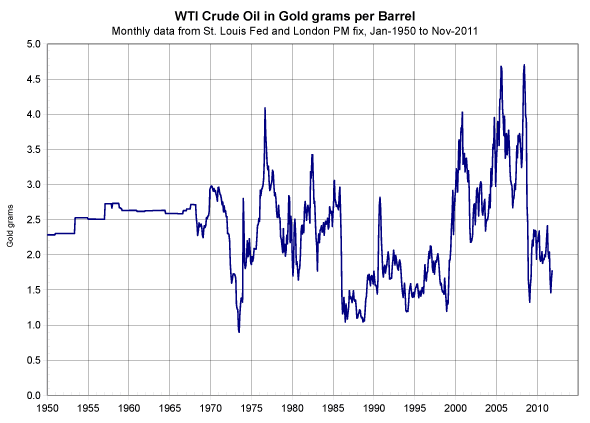
A sad little truth that most politicians don't like to mention is that oil is traded in dollars, therefore if the value of a dollar falls the price of oil rises. When you print more dollars you will need more of them to buy a global commodity such as oil. Now of course oil is also a commodity driven by supply and demand. When demand increases globally, especially in fast growing emerging markets, the price tends to rise. Also when there are threats to supply, like a war between Iran and Israel, prices tend to rise. But the real culprit is the easiest monetary policies in history. As the 1st graph below shows it's a little more than a coincidence that oil prices sore in conjunction with the Fed's massive liquidity injections known as QE1, QE2, and Twist. 

The second graph below shows oil priced in gold. As you can see, oil is volatile, but it has averaged around 2 grams of gold per barrel since 1950. Oil priced in gold has actually been declining over the last couple of years. This is simply because the value of gold, priced in ever depreciating dollars, has climbed.


A better more current graphic can be found at the following link... Wikipedia


The next time a politician tries to tell you sweet little lies about greedy oil companies, Wall Street speculators, etc.; remember it's not the price of oil that's the problem, it's the declining value of the paper money in your wallet.

Ron Paul is the only Presidential candidate (including the President) who understands the great theft going on in America today. Here he takes the time out from his campaign to question Ben Bernanke on the continuing debasement of the dollar. Enjoy:


Recently our commodity indicators moved to bullish territory (following the flow of money), therefore we increased our weight in commodities, gold, and emerging market bonds.

Be careful out there, and keep the lights on,

Chris Wiles, CFA
412-260-7917


For prior Rockhaven Views visit:

This article contains the current opinions of the author but not necessarily those of the Rockhaven Capital Management.  The author’s opinions are subject to change without notice. This article is distributed for informational purposes only. Forecasts, estimates, and certain information contained herein are based upon proprietary research and should not be considered as investment advice or a recommendation of any particular security, strategy or investment product. Information contained herein has been obtained from sources believed to be reliable, but not guaranteed.


Friday, February 17, 2012

Rumour Has It

All these words whispered in my ear
Tell a story that I cannot bear to hear
Just 'cause I said it, it don't mean that I meant it
People say crazy things


Lately I've struggled with writing this note. I'm at one of those points where there is just so much to comment on, that I am having trouble deciding where to start. I'm also grappling with the fact that so much of what is being "whispered in my ear, tell a story that I cannot bear to hear."  

First, I've been wrestling with how to describe my feelings concerning what I see as the "real" divide in America. I don't think it is a democrat/republican or conservative/liberal split. And I don't even believe that it is a 99% vs 1% battle. No, to me the country has become more and more divided into those that have "skin-in-the-game" and those that don't, the "elites". This is the divide in the Western world today, not rich versus poor. The "elites" are generally made up of politicians, some Wall Street executives, many in the mainstream media, the powerful heads of labor unions, and the CEO's of many large state-connected and protected multi-national corporations. They have created a world in which they can reap most of the upside and suffer none of the downside, they have no skin-in-the-game. 

The other 99% of us with "skin-in-the-game" are the unconnected wealthy, the middle class, and the poor. The elites would like us to think its class warfare, rich versus middle class and poor, but it's not. We don't begrudge those that have taken risks with their own money, and either failed or become wealthy. We begrudge those who take risk with other peoples money, and never personally fail. The Occupy Wall Streeters were on the right track, but they failed to differentiate between true capitalism and crony-capitalism or fascism. Capitalism, as it used to be practiced, lifted millions out of poverty. Today's bastardized crony capitalism, robs from the successful risk takers, and keeps millions from pursuing their dreams. The battle is not against wealth, it is against power and the abuse of power. Certainly wealth can and does, buy power, but wealth, in and of itself, is not evil. 

Speaking of those with skin-in-the-game, is there any group with more skin-in-the-game than our military. They risk it all for little or no upside. They represent the citizens, and fight for an ideal of personal freedom and responsibility. What happens when they realize that they are fighting to protect the elites, and not the constitution. Why do you think Ron Paul has more military support than all the other candidates combined? 

This is not just a US issue, look at what's happening in Greece. Sure the Greek economy is a hopeless basket case, but when you have the Federation of Greek Police threaten to issue arrest warrants to EU/IMF officials accused of "...blackmail, covertly abolishing or eroding democracy and national sovereignty," there is something deeper going on here. People around the world are waking up to the fact that the system has been massively corrupted. Capitalism is not the problem, crony-capitalism is.

It's Halftime America 

Clint Eastwood has drawn a lot of criticism for his Super Bowl halftime commercial for Chrysler (oops, Fiat). The main objection to the ad is that Clint (an avowed Libertarian) touts the success of a company that deserved to fail, but was instead bailed out with other peoples money (yours), as the "new" American way. It is total propaganda from our current ruling elite. Not sure what Clint's motivation was, but it was sad. 
Here is a much better version of the commercial brought to us by Omid Melikan. Please take four minutes to watch them both, which do you prefer?


Here's where we stand today in our Global Tactical Asset Allocation Portfolios:

Surprisingly, while many big picture issues are quite troubling, stocks are nearing four year highs ( the media tries to make this sound great, but all it really means is that for the last four years you've made nothing). In spite of Washington's interference, corporate America is showing signs of growth. I'm taking this growth with a grain of salt (actually I've always liked a little salt on my apple). Apple has grown so large so fast, that it is distorting the growth figures being reported in the S&P 500. In the fourth quarter the S&P 500 is showing earnings growth of 6.6%, but excluding Apple's 116% earnings growth, the earnings growth for the other 499 companies drops to 2.8%!

We will continue to diversify and take what the markets are giving us: 

US Equities -- 20% Bullish,
 we are now at our full US equity weight.
Int'l Equities -- 12% Neutral,
 we have now moved to neutral in our International equity weight. 
US REITs --  6% 
Bullish, we are now at our full US REIT target of 6%.
Int'l REITs -- 2% Neutral, international REITs have moved out of bearish territory
.
Gold --6% Neutral, Gold is neutral but the gold miners have been acting poorly.
Commodities -- 6% Neutral, the appearance of economic stability has caused commodities to begin rising
.
US Fixed Income -- 29% Bullish, the stabilization in the economy is slowing the flight to safety, and US fixed income is showing signs of slipping into neutral territory.
Int'l Fixed Income -- 3% Neutral, We continue to have zero exposure to European & Japanese bonds, but we are at neutral exposure to Emerging Market bonds.
Cash Equivalents & Currencies -- 18%, cash levels fall and are divided between the US at 10%, 5% in China, and 3% Australia.

Is Bernanke Part Of Italian Mafia?

Strange news story coming out of Switzerland today ( Italy Police Seize $6 Trillion of Fake U.S. Treasury Bonds in ... ) . It appears that the Italian anti-mafia police have seized $6 trillion (yes trillion with a T), of counterfeit  US Treasury bonds from Swiss safety deposit boxes. The strange thing is that they were dated 1934 and had a nominal value of $1 billion apiece. Now $1 billion in 1934 was bigger than our GDP, and the US has never issued a $1 billion note. Why would you go through the effort of making sophisticated, high quality, counterfeit treasury bonds that are clearly counterfeit? And they were going to use these clearly fake, but painstakingly realistic bonds to buy plutonium from Nigerians? Only one 15 second mention of this the entire day on CNBC. The cases the bonds were in appear to be genuine or very good counterfeits. Very weird!

The problem with fiat money is that it's only as good as the paper it's printed on. Head scratcher.

Here is what the bonds and the boxes look like:


NOTA Way Ahead In Polls:

In the race for the Presidency of The United States NOTA (None 0f the Above) is still way ahead in the polls. I'm starting a Super Pac for NOTA. I'm sure the kid would get the recognition he deserves if he was only able to get his message out. If you would like to contribute give me a call.

Be careful out there, and keep the lights on,

Chris Wiles, CFA
412-260-7917


For prior Rockhaven Views visit:

This article contains the current opinions of the author but not necessarily those of the Rockhaven Capital Management.  The author’s opinions are subject to change without notice. This article is distributed for informational purposes only. Forecasts, estimates, and certain information contained herein are based upon proprietary research and should not be considered as investment advice or a recommendation of any particular security, strategy or investment product. Information contained herein has been obtained from sources believed to be reliable, but not guaranteed.


Wednesday, February 1, 2012

Something For Nothing

You can't get something for nothing
You can't have freedom for free
You won't get wise
With the sleep still in your eyes
No matter what your dreams might be


On this first day of February 2012 (2/1/12), I thought I'd offer up a little tribute to Rush and their 2112 album. 

As January Goes, So Goes the Year -

January was a pretty special month for the "Risk-on" crowd. The S&P 500 was up 4.61%, this was the best January since 1997, 15 years ago. Developed market international stocks were up 5.27%, and Emerging Market stocks were up 10.78%. The yellow metal, Gold, was up a glittering 11.40%. Most "Risk-off" assets, like US Treasuries were flat, long-term US treasury bonds were up 0.57%. All in all a great way to start the New Year.

There's an old Wall Street adage, "As January goes, so goes the year". Many talking heads have been rolling this out over the last week, and on its face the numbers look impressive. In the 82 years since 1926, this metric worked 70% of the time. But in those 82 years the market was actually up 76% of the time. When January is a down year, however, the probability that the rest of the year is down is just 35%. In fact a statistician will tell you that only 1% of the variation in yearly performance is explained by January's performance.

Don't get me wrong, I love an up market, it makes me look smart. Just don't believe that the rest of the year is clear sailing. 

ZIRP May Not Be Good For Stocks - 

Another common refrain, is that the Fed's zero interest rate policy (ZIRP), will force investors into higher risk assets, especially dividend paying stocks. While this makes intuitive sense, in the real world it doesn't always work that way. There was a period in the late 1940's and early 1950's when the Fed forced rates to very low levels to try and stimulate the economy. There are some interesting similarities between that time period and today. The Fed was saddled with a very high debt to GDP, which was caused by the cumulative effects of WWI and WWII. Even with an extraordinarily accommodative monetary policy and negative real rates P/E multiples on the S&P 500 fell below 7x. Investors didn't care, they were risk averse. The world was an uncertain place, another war was on the horizon (Korea), and the country was cautious.

Today we have a similar scenario. We are faced with a monstrous mountain of debt (built up by decades of overconsumption), and we are limping out of one financial crisis facing the prospect of more (Europe & Here). The Fed is doing its best to stimulate demand (encourage inflation), but Americans just aren't buying it. As mentioned above, we had the best January in 15 years, but January's volume on the NYSE was down 26% year-over-year, and down a whopping 59% from January of 2008. A Wall Street trader was quoted as saying, "Our desk is dead!" 

The Fed is pushing, and pushing hard, to get investors to take on more risk, but maybe investors just aren't that stupid. With total ineptitude in Washington (both parties), a mountain of debt that neither party is addressing, a tenuous global situation (both economic & political), is it any wonder that investors are sitting on their hands channeling Mark Twain ... "It's not the return on my principal, it's the return of my principal." 

If interest rates are pegged at zero for six years, its inevitable that the volatility of inflationary expectations will rise (witness gold). If the volatility of inflationary expectations rise P/E multiples decline. Stocks can head higher, just don't believe that it is a given, just because interest rates are at zero.

Below is a graph that shows Price to Earnings multiples over time. By this metric, stocks aren't exactly cheap.


Average holding period for a stock increased 10% last year -

Another interesting factoid. The average holding period for a stock increased by 10% in 2011, from 20 seconds to 22 seconds. Computer generated high frequency trades (HFT) accounted for 70% of all volume!

Life - and Death Proposition -

Please enjoy Bill Gross of PIMCO's recent piece, some excellent food for thought.

Be careful out there, and keep the lights on,

Chris Wiles, CFA
412-260-7917


For prior Rockhaven Views visit:

This article contains the current opinions of the author but not necessarily those of the Rockhaven Capital Management.  The author’s opinions are subject to change without notice. This article is distributed for informational purposes only. Forecasts, estimates, and certain information contained herein are based upon proprietary research and should not be considered as investment advice or a recommendation of any particular security, strategy or investment product. Information contained herein has been obtained from sources believed to be reliable, but not guaranteed.